
A B2B lead generation funnel turns early interest into a qualified sales opportunity through a sequence of measurable stages. For a performance marketing agency, the funnel is more than a set of ads and landing pages: it is a connected system that links audience research, paid acquisition, search visibility, conversion rate optimization, lead nurturing, sales handoff, and revenue attribution.
The target keyword, B2B lead generation funnel best practices, covers the operational choices that help a business attract appropriate prospects, capture useful information, assess intent, and improve the path from first interaction to closed business. Because B2B purchases often involve multiple stakeholders and longer decision cycles, a funnel should support both immediate conversions and continued education.
What Is a B2B Lead Generation Funnel?
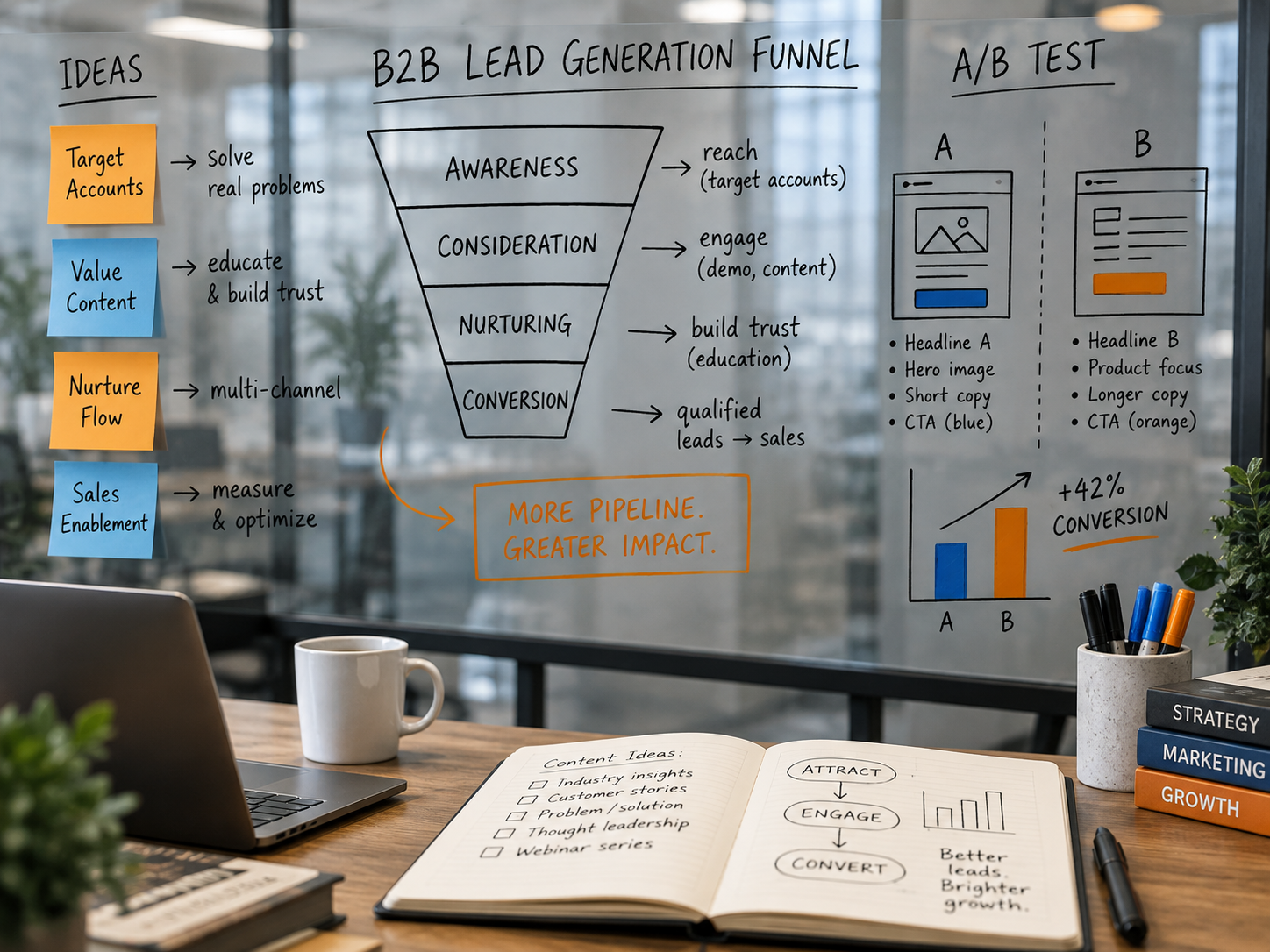
A B2B lead generation funnel is a framework for moving potential business buyers through stages of awareness, consideration, evaluation, and sales readiness. Each stage has a different purpose and should be measured with an appropriate outcome.
- Awareness: A potential buyer discovers a company through search, paid ads, social media, referrals, or industry content.
- Consideration: The visitor evaluates whether the company understands the problem and offers a credible solution.
- Conversion: The visitor completes an action such as requesting a consultation, downloading a resource, registering for a webinar, or submitting an inquiry.
- Qualification: Marketing and sales assess fit, need, authority, timing, and likely commercial value.
- Opportunity and revenue: A qualified lead enters a sales process, and the organization connects eventual revenue back to the campaigns and interactions that influenced it.
These stages are not always linear. A prospect may return to a pricing page several times, engage with a sales representative, and then share a piece of content internally before becoming an opportunity. The funnel is therefore a measurement model and workflow, not a claim that every buyer follows one fixed route.
Best Practices for Building the Funnel
1. Define the ideal customer profile and buying situations
Start with a precise ideal customer profile (ICP). Document the industries, company sizes, locations, technology environments, business problems, and buying triggers that make an account a plausible fit. Then identify the roles involved in the purchase. A finance leader, technical evaluator, end user, and executive sponsor may all need different evidence.
Separate firmographic fit from behavioral intent. A company can match the ICP but have no current need, while a smaller organization may show strong intent but fall outside the service model. This distinction helps prevent an agency from optimizing only for inexpensive form submissions.
Useful research inputs include customer interviews, sales-call notes, CRM opportunity data, support questions, search query reports, and lost-deal analysis. Avoid treating a single persona document as permanent. Review it when win rates, product positioning, or market conditions change.
2. Map content to each funnel stage
Content should answer the question a buyer is asking at a particular stage. Awareness content can address symptoms, industry changes, and problem definitions. Consideration content can compare approaches, explain implementation requirements, and show how different solutions work. Evaluation content can include service details, technical documentation, case studies, security information, and buying guides.
For SEO and content strategy, build topic clusters around the problems your ICP searches for rather than publishing disconnected keyword articles. Map each important page to a business purpose, a primary audience, an intended action, and an internal linking path.
Paid campaigns can accelerate distribution, but paid traffic should not compensate for unclear positioning. Search ads, social media ad campaigns, and retargeting are more useful when the destination page makes a specific promise that matches the audience’s context.
3. Choose channels according to intent and buying behavior
There is no universally best acquisition channel. Search advertising can capture explicit demand, while LinkedIn or other professional social platforms may help reach defined job functions and account segments. Organic search can compound over time, but it requires sustained content quality and technical maintenance. Email can nurture known contacts, but it cannot replace a credible acquisition strategy.
Use channel roles rather than forcing every platform to produce the same conversion. For example, a paid search campaign may target high-intent queries, a social campaign may introduce a point of view to a narrowly defined audience, and email marketing automation may help an existing contact evaluate a solution.
For paid ads and PPC optimization, organize campaigns around intent, audience, offer, and landing page relevance. Review search terms, placement quality, conversion signals, and downstream lead quality. A campaign with a lower cost per lead is not automatically more efficient if its leads rarely become qualified opportunities.
4. Design landing pages around one clear decision
A B2B landing page should make the next action understandable without requiring the visitor to interpret a large amount of unrelated information. The page should usually include a direct headline, a clear explanation of the business problem, evidence appropriate to the claim, relevant process or deliverable details, and a form or other conversion mechanism.
Form length should reflect the value of the offer and the qualification requirements. A short form may reduce friction, while additional fields can help sales prioritize accounts. Collect only information that has a defined operational use. If a field is never used by marketing or sales, it may create friction without improving qualification.
Landing page design and testing should follow a controlled process. Establish a baseline, identify one meaningful hypothesis, define the primary conversion and guardrail metrics, and allow enough time and volume for the result to be interpretable. Test message, offer, audience, form structure, page hierarchy, and calls to action. Avoid declaring a winner from a small or heavily overlapping sample.
5. Create a qualification model that sales can use
Marketing-qualified lead and sales-qualified lead definitions should be written in operational terms. A lead might be considered sales-ready when it matches a target account profile, has expressed a relevant business need, has provided usable contact information, and has reached an agreed level of engagement or requested a commercial conversation.
Lead scoring can combine explicit data, such as company role and industry, with behavioral data, such as visits to service pages or responses to a business-focused email. Scores should not be treated as proof of purchase intent. They are prioritization aids and should be checked against sales outcomes.
Agree on response ownership, service-level expectations, disqualification reasons, and feedback fields. If sales repeatedly rejects leads for the same reason, update targeting, forms, scoring, or messaging. The funnel improves when lead-quality feedback moves back into campaign decisions.
6. Use email marketing automation with restraint
Email automation can deliver relevant follow-up based on content downloads, event attendance, product interest, or declared business needs. A useful sequence provides context, answers objections, and offers an appropriate next step. It should also include frequency controls, preference management, and a clear way to stop or change communications.
Segment contacts by meaningful differences rather than adding unnecessary complexity. A technical evaluator may need implementation detail, while an executive sponsor may need business outcomes and risk information. Avoid sending a generic sequence to every contact regardless of their role or stage.
Measure reply quality, meeting acceptance, opportunity creation, unsubscribes, and revenue influence alongside email engagement. Opens and clicks can be affected by privacy controls, security systems, and automated scanning, so they should not be the only evidence of performance.
Measurement, Attribution, and Optimization
Connect marketing events to business outcomes
Define a measurement plan before launching campaigns. At minimum, document the source and medium, campaign and creative identifiers, landing page, conversion event, lead status, opportunity status, and revenue fields that will be used for analysis. Use consistent naming conventions across advertising platforms, analytics, marketing automation, and the CRM.
Google Analytics 4 documentation describes event-based measurement and recommends defining events that reflect meaningful user interactions. Google Ads Help explains conversion tracking and the use of conversion actions for evaluating advertising outcomes. These are useful primary references for implementation, but the business still needs to decide which events represent qualified value.
Marketing analytics and attribution should distinguish between:
- Acquisition metrics: impressions, visits, engaged sessions, and traffic quality.
- Conversion metrics: form completions, calls, registrations, and other agreed actions.
- Qualification metrics: accepted leads, meetings, opportunities, and pipeline value.
- Commercial metrics: closed revenue, gross margin, customer retention, and return on investment.
A useful dashboard connects these layers while preserving the ability to inspect individual records. Report conversion rates by channel, audience, landing page, offer, and funnel stage. Also check time lag: a channel may appear weak in a short reporting window if its leads require longer evaluation.
Use attribution models carefully
Attribution assigns credit for a conversion or revenue outcome to one or more marketing interactions. First-touch reporting can show which channels introduce prospects. Last-touch reporting can show what preceded a conversion. Multi-touch models can distribute credit across several interactions, but they depend on reliable data and assumptions about influence.
No attribution model proves that marketing caused revenue by itself. Direct traffic, sales outreach, brand familiarity, partner activity, offline interactions, and untracked research can all affect the decision. Compare multiple views, record exclusions, and avoid presenting model outputs as precise causal measurements.
When practical, use incrementality methods such as geographic comparisons, audience holdouts, or changes in budget allocation with appropriate controls. The exact approach depends on traffic volume, sales-cycle length, privacy constraints, and the ability to keep other factors stable. A performance marketing agency should explain the methodology and limitations rather than reporting a single return figure without context.
Optimize for qualified pipeline, not superficial efficiency
Common optimization targets include cost per lead, conversion rate, cost per qualified lead, opportunity rate, pipeline generated, and revenue return. Each metric answers a different question. Cost per lead can help manage acquisition efficiency, but it may reward broad targeting or low-friction forms. Opportunity rate can reveal lead quality, while revenue return may be delayed and affected by sales execution.
Set a primary metric for each funnel stage and a business-level metric for budget decisions. Review cohorts over a consistent period and annotate major changes such as pricing, targeting, sales capacity, tracking changes, or website releases.
Pros and Cons of a Funnel-Based Approach
Advantages:
- It gives teams a shared vocabulary for audience, content, conversion, qualification, and revenue.
- It reveals where prospects are being lost, such as weak landing pages or poor sales follow-up.
- It supports channel comparisons beyond traffic volume and form count.
- It makes testing more focused because each experiment has a defined stage and outcome.
Limitations:
- B2B buyers do not always move through stages in a predictable order.
- Long sales cycles delay feedback and make short-term optimization less reliable.
- Attribution can be incomplete when research happens across devices, offline channels, or multiple stakeholders.
- Detailed funnels can create administrative overhead if teams collect data that is not used.
- Lead scoring and automation can create false confidence when the underlying definitions are weak.
The practical response is to keep the model useful and revisable. Use enough detail to make decisions, but avoid measuring every interaction simply because a platform can record it.
How a Performance Marketing Agency Can Scale the System
Scaling should follow evidence from the existing funnel. First, confirm that tracking is consistent and that sales feedback is available. Next, identify the constraint with the greatest commercial impact: insufficient qualified traffic, weak conversion, poor lead routing, low meeting acceptance, or weak opportunity progression.
Expand audiences only after the current ICP and offer show credible downstream performance. Create reusable campaign structures, landing page templates, testing documentation, and reporting definitions, while allowing each market segment to retain relevant messaging. Automate repetitive data collection and alerts, but keep human review for budget changes, brand claims, exclusions, and lead-quality decisions.
Scaling performance marketing also requires operational capacity. More leads are not beneficial when response times increase, sales teams cannot follow up, or onboarding cannot support new customers. Include sales and service constraints in forecasts and treat customer quality and retention as part of acquisition performance.
Practical Implementation Checklist
- Write the ICP, buying triggers, target roles, and disqualification criteria.
- Map the buyer’s questions and objections to content and offers by stage.
- Assign a clear role to SEO, paid search, social media, partners, and email.
- Build landing pages with message continuity, credible evidence, and a purposeful form.
- Define lead, MQL, SQL, opportunity, and revenue rules with sales.
- Implement consistent campaign parameters and CRM source fields.
- Validate key events and lead handoffs before spending significant budget.
- Set stage-level metrics and inspect lead quality through opportunity and revenue data.
- Run one well-defined conversion rate optimization test at a time when possible.
- Review results by cohort and document changes, assumptions, and limitations.
Q&A
What is the most important B2B funnel metric?
There is no single metric for every stage. For business decisions, qualified pipeline and revenue are generally more informative than raw leads, while conversion rate and cost per lead can help diagnose earlier-stage performance.
Should every B2B lead go directly to sales?
No. A direct sales route may suit high-intent inquiries, but educational downloads or early research actions may need qualification and nurturing first. Define routing rules based on fit, intent, capacity, and the prospect’s stated preference.
How often should landing pages be tested?
Test continuously when there is a clear hypothesis and enough reliable conversion data to interpret the result. Prioritize changes that address observed friction or message mismatch rather than changing elements at random.
Is paid advertising required for B2B lead generation?
No. Organic search, referrals, partnerships, events, communities, and outbound programs can all contribute. Paid advertising can provide reach and testing speed, but it requires disciplined targeting, tracking, and budget control.
Conclusion
The strongest B2B lead generation funnel best practices connect buyer understanding with measurable execution. Define the audience and buying context, align content and channels with intent, design focused conversion paths, qualify leads with sales input, and connect marketing activity to pipeline and revenue where the data permits.
Use Google Analytics 4 and Google Ads documentation as implementation references, then adapt measurement to the organization’s CRM, sales cycle, privacy requirements, and commercial model. Results will vary by market, offer, budget, competition, tracking quality, and sales execution. Marketing budgets involve financial risk, so campaign decisions should be validated with the organization’s own data and reviewed by qualified marketing, finance, and legal stakeholders where appropriate. This article is general informational guidance, not financial or legal advice.
Leave a Reply