
In performance marketing, traffic is only the beginning. A paid search campaign, social media ad, or SEO landing page can attract the right visitors, yet still produce weak results if the page, offer, or follow-up process does not support action. This is where conversion rate optimization, or CRO, becomes central.
The phrase “conversion rate optimization CRO adalah” can be understood as “what conversion rate optimization CRO is.” CRO is the structured process of improving a website, landing page, funnel, or campaign experience so that a higher share of qualified visitors complete a desired action. That action might be submitting a B2B form, booking a consultation, requesting a quote, starting a trial, purchasing a product, or subscribing to an email list.
For a performance marketing agency, CRO is not limited to changing button colors. It connects paid advertising, landing page design, analytics, messaging, sales processes, and customer value. The goal is to make marketing spend produce more useful outcomes while preserving data quality and customer experience.
What Does Conversion Rate Optimization Mean?
A conversion rate is the proportion of visitors or users who complete a defined conversion event. A basic formula is:
Conversion rate = conversions ÷ relevant visitors or sessions × 100
The relevant denominator depends on the question being asked. An agency may measure landing page submissions against landing page sessions, qualified leads against form submissions, or purchases against checkout sessions. Mixing these definitions can make a campaign appear to improve when the underlying business result has not changed.
CRO begins by defining the business outcome and the user action that signals progress. It then uses evidence to identify friction, uncertainty, poor message alignment, technical problems, or weak offers. Changes are tested or measured carefully, and the results are used to guide the next iteration.
CRO Is More Than Interface Design
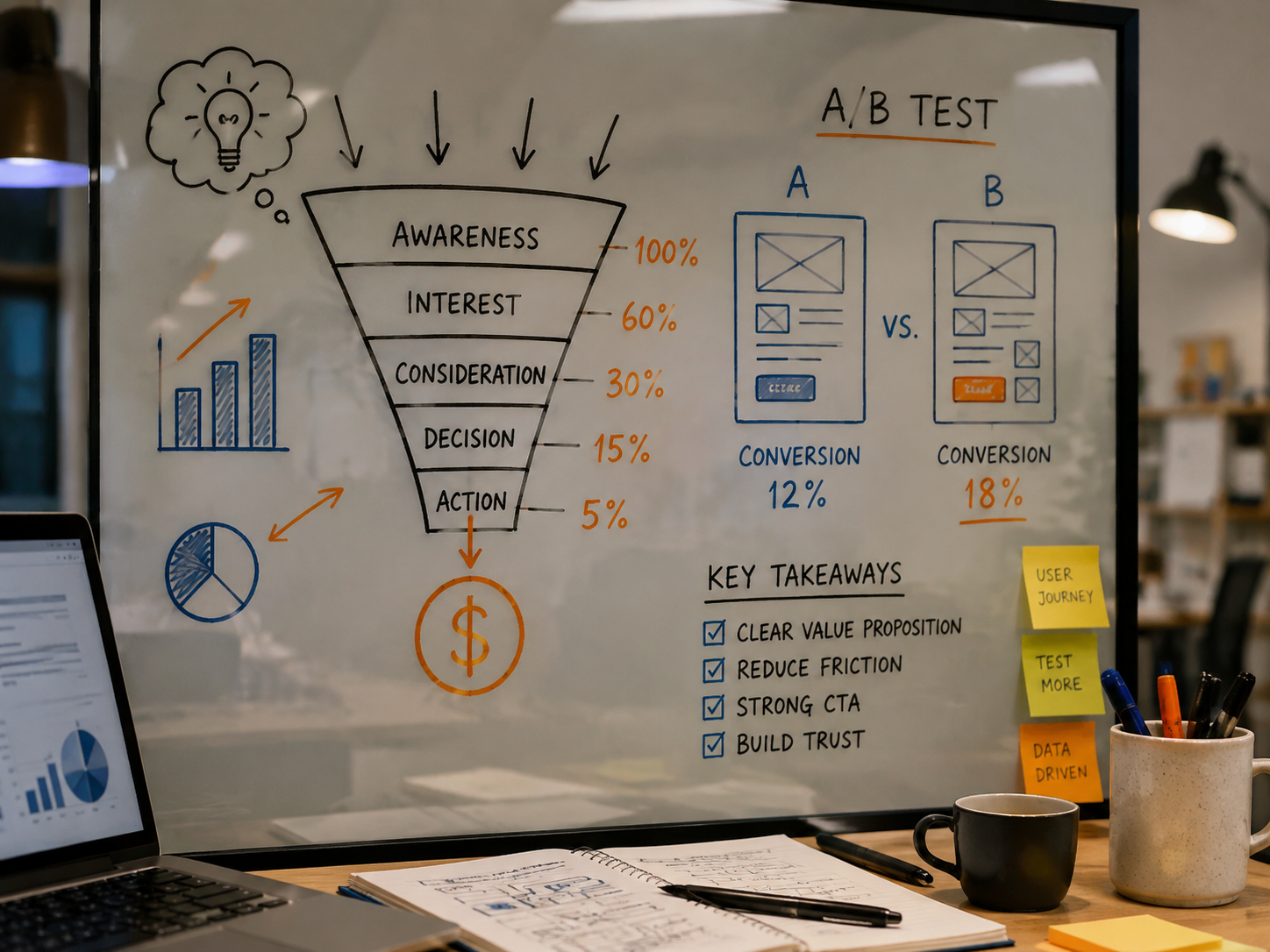
Landing page design is part of CRO, but it is only one component. Conversion performance can be affected by:
- The promise made in the ad or search result
- The match between the visitor’s intent and the landing page
- The clarity of the offer and call to action
- Form length, field requirements, and error handling
- Page speed and mobile usability
- Trust signals, proof, guarantees, and security information
- Lead routing, response time, and sales qualification
- Attribution rules and the quality of analytics data
A page can have a strong conversion rate and still create poor commercial results if it generates low-quality leads. A mature CRO program therefore evaluates both the action rate and what happens after the action.
Why CRO Matters to a Performance Marketing Agency
Performance marketing agencies are often judged by measurable outcomes such as qualified leads, revenue, customer acquisition cost, return on ad spend, or pipeline contribution. Increasing media spend can increase volume, but it may also expose weaknesses in the funnel. CRO helps an agency improve the efficiency of existing demand before expanding acquisition.
It also creates a stronger connection between campaign management and business operations. Paid media specialists can identify which search terms, audiences, and ad messages attract intent. UX and content specialists can turn those insights into clearer landing pages. Analysts can connect page behavior to lead quality and revenue. Together, these disciplines provide a more reliable basis for decisions.
CRO should not be treated as a promise that every change will produce a higher rate. Some tests will have no meaningful impact. Others may increase form submissions while reducing qualified opportunities. The value of the process comes from disciplined learning and better allocation of budget, attention, and development time.
How CRO Connects With Paid Ads and PPC Optimization
Paid search and paid social campaigns often expose a landing page to visitors with different needs. Someone searching for a specific service may be ready to compare providers, while someone responding to a social ad may need more education. Sending both audiences to the same generic page can reduce message relevance.
A performance marketing agency can improve alignment by connecting each major campaign theme to a relevant destination. The headline, supporting copy, proof, offer, and call to action should reflect the visitor’s likely intent. If an ad promotes a paid media audit, the destination should explain that audit rather than presenting a broad list of agency services.
Important PPC and CRO Checks
- Compare the wording of the ad with the landing page headline.
- Review search terms and audience segments for differences in intent.
- Separate branded, non-branded, competitor, and high-intent service traffic where useful.
- Check whether mobile visitors encounter unnecessary fields or difficult navigation.
- Review post-click engagement by campaign, device, geography, and audience.
- Measure qualified outcomes instead of optimizing only for inexpensive clicks or leads.
Quality score, click-through rate, and cost per click can help diagnose campaign health, but they do not replace conversion and revenue analysis. A campaign that earns fewer clicks but produces better opportunities may deserve more budget than a campaign with a lower click cost.
Landing Page Design and Testing
Effective landing pages make the next step easy to understand. They answer the visitor’s main questions in a logical order: What is being offered? Who is it for? Why should I believe the claim? What happens after I respond? What information is required from me?
A practical page structure may include a specific headline, a short explanation of the outcome, supporting evidence, a clear offer, objection handling, and a visible call to action. The exact structure should reflect the audience and buying process. A high-consideration B2B service may need case evidence, methodology, team credentials, and qualification details. A simple product offer may need less explanation and a faster path to checkout.
Testing Ideas That Have a Clear Reason
Tests should be connected to an observation or hypothesis. Examples include:
- Rewriting the headline to match the highest-intent search language.
- Replacing a vague call to action with one that names the next step.
- Moving key proof closer to the form or purchase decision.
- Reducing form fields that are not needed for qualification.
- Adding an explanation of response time after form submission.
- Creating separate pages for distinct services, industries, or use cases.
- Improving error messages so users can correct a form without losing entries.
Testing should account for the primary conversion, secondary behaviors, and downstream quality. A page variant that increases submissions but causes sales teams to reject more leads may not be a successful variant. Where traffic volume is limited, qualitative research, session recordings, customer interviews, form analysis, and before-and-after comparisons can complement formal split testing.
SEO and Content Strategy in CRO
SEO and CRO work together when content attracts visitors who have a meaningful reason to continue. Search-focused content should satisfy the query while offering a relevant next step. A guide for users researching PPC management, for example, can connect to an audit, benchmark, consultation, or deeper comparison page when that offer fits the reader’s stage.
Content should not force an aggressive sales message onto every visit. Informational readers may need definitions, examples, and practical guidance before they are ready to contact an agency. Commercial pages can be more direct, with stronger proof and clearer conversion paths.
Search intent is especially important for the target phrase “conversion rate optimization cro adalah.” A useful article should explain the meaning of CRO, distinguish it from general website redesign, and show how the discipline works in a performance marketing context. Clear terminology improves both reader comprehension and the chance that the page meets the searcher’s actual need.
Marketing Analytics and Attribution
CRO decisions depend on trustworthy measurement. Before launching a test, an agency should document the conversion event, source of truth, tracking method, reporting window, and relevant segments. It should also confirm that duplicate events, accidental reloads, spam submissions, and cross-domain issues are not distorting the data.
Analytics should connect the user journey across the major stages of the funnel. Useful stages may include ad interaction, landing page visit, form start, form completion, marketing-qualified lead, sales-qualified lead, opportunity, and closed revenue. The exact stages vary by business, but the principle is consistent: the agency should understand whether an apparent conversion is valuable.
ROI Tracking and Attribution Considerations
Attribution models assign credit for a conversion across marketing interactions. No single model perfectly explains every customer journey. Last-click attribution may be easy to interpret but can undervalue earlier research activity. First-click attribution highlights acquisition but may overlook the interactions that helped close the deal. Data-driven approaches can be useful when data quality and volume support them, but they still depend on sound definitions.
For CRO, attribution is important because a landing page may influence several outcomes. A visitor might download a guide, return through email, attend a sales call, and later become a customer. The initial conversion matters, but it should be evaluated alongside assisted activity and revenue contribution. Agencies should state their attribution assumptions clearly so stakeholders understand what the reports do and do not prove.
CRO for B2B Lead Generation
B2B conversion paths often involve multiple people, longer consideration periods, and a meaningful gap between a form fill and revenue. This makes lead quality and qualification especially important.
Useful B2B lead generation tactics include creating service-specific pages, offering a useful assessment or benchmark, using forms that collect only actionable information, and setting clear expectations for the next conversation. A form should support sales qualification without demanding information that the visitor cannot reasonably provide.
Trust is also a major part of B2B CRO. Relevant case studies, client categories, implementation details, security information, certifications, and transparent process descriptions can reduce uncertainty. Proof should be specific enough to be credible and relevant enough to match the audience’s problem.
Lead handling belongs in the optimization loop. If a qualified lead receives a slow response, unclear scheduling options, or a generic follow-up, improving the landing page alone will have limited effect. Marketing and sales should agree on lead definitions, ownership, response expectations, and feedback mechanisms.
Social Media Ad Campaigns and CRO
Social media ad campaigns can reach users before they have formed a clear buying intention. Creative and landing page continuity therefore matters. The visual, promise, audience context, and tone of the ad should make sense when the visitor arrives on the page.
Agencies should review performance by placement, creative, audience, device, and landing page. A low-cost lead from a broad audience may not carry the same value as a lead from a narrowly defined professional segment. Lead validation and CRM outcomes help reveal these differences.
Social traffic may also respond well to different conversion paths. A direct consultation request can work for a warm retargeting audience, while a comparison guide, webinar, or email sequence may be more appropriate for a new audience. CRO means matching the action to the visitor’s readiness, not forcing every visitor into the same form.
Email Marketing Automation After the Conversion
The first conversion often begins a relationship rather than ending one. Email marketing automation can provide confirmation, deliver requested material, prepare the lead for a sales conversation, and identify additional intent signals.
Automation should reflect the user’s original action. Someone who requested a PPC audit should receive relevant confirmation and follow-up content, not an unrelated product sequence. Messages should provide a clear reason to continue, use accurate personalization, and include an easy way to manage preferences.
These email interactions can also support CRO analysis. Opens and clicks are incomplete signals, but they may help identify which topics or objections deserve attention on future landing pages. More meaningful indicators include booked meetings, replies, qualified opportunities, and revenue associated with the sequence.
Scaling a Performance Marketing Agency CRO Program
Scaling CRO requires a repeatable operating process. Start with a shared measurement framework and a prioritized backlog. Each item should include the observed problem, evidence, proposed change, expected effect, effort, risk, and success metric.
Prioritization should consider business value and confidence, not just the number of page visits. A high-traffic page with a minor usability issue may be less valuable than a lower-traffic page serving an important, high-margin service. Agencies should also reserve capacity for tracking repairs and technical improvements, since unreliable measurement can invalidate otherwise useful work.
When an agency manages several accounts, reusable principles can accelerate delivery without producing identical pages. Templates may standardize analytics events, experiment documentation, QA checks, and reporting. The offer, proof, language, and user journey should still be adapted to each client’s market.
A Practical CRO Workflow
- Define the commercial goal and primary conversion.
- Audit tracking, funnel stages, landing pages, campaigns, and lead quality.
- Collect evidence from analytics, user research, sales feedback, and customer support.
- Prioritize the highest-value friction points.
- Write a testable hypothesis and define success conditions.
- Build the change and complete functional, mobile, accessibility, and tracking QA.
- Run the test or comparison for an appropriate period and review relevant segments.
- Assess primary conversions together with quality, pipeline, revenue, and user experience.
- Document the result and apply the learning to related campaigns or pages.
Concise Q&A
What is conversion rate optimization CRO?
CRO is the evidence-based process of improving a digital journey so more relevant visitors complete a valuable action.
What does “conversion rate optimization CRO adalah” mean?
It means “what conversion rate optimization CRO is.” The phrase refers to a definition or explanation of CRO.
Is CRO the same as SEO?
No. SEO focuses on earning relevant organic visibility and traffic. CRO focuses on improving the percentage and quality of visitors who take the desired next step. They support each other.
How does a performance marketing agency measure CRO?
It can measure landing page conversions, qualified leads, sales opportunities, revenue, acquisition cost, and other agreed business outcomes, using clearly defined tracking and attribution rules.
Does every CRO change require an A/B test?
No. A/B testing is useful when traffic and measurement support it. Research, technical fixes, usability reviews, and controlled before-and-after analysis can also guide improvements.
Conclusion
Conversion rate optimization is the discipline that turns marketing attention into more useful action. For a performance marketing agency, it links PPC optimization, SEO and content strategy, landing page testing, analytics, attribution, B2B lead generation, social advertising, email automation, and commercial outcomes.
The strongest CRO programs are grounded in clear definitions and real evidence. They improve the visitor’s path while protecting lead quality, reporting accuracy, and long-term return. By treating every conversion as part of a broader customer journey, an agency can make better decisions about campaigns, pages, budget, and growth.
Leave a Reply