
People often search by describing a problem or asking a complete question, rather than typing a short product term. AI-powered search experiences make that behavior more visible: a user may ask for a comparison, a recommendation, or a next step and receive a synthesized response. For performance marketers, those questions can reveal useful language and intent. They can also create noise if treated as proof of search volume or buying demand.
This guide explains how to use AI search questions for keyword research without confusing an interesting prompt with a validated paid-search opportunity. The process combines question discovery, intent classification, keyword and audience validation, landing-page alignment, and measurement. It is relevant to a performance marketing agency or an in-house team planning paid ads and PPC optimization alongside SEO and content strategy.
What Are AI Search Questions?
AI search questions are natural-language queries people enter into AI-assisted search interfaces, conversational assistants, or search experiences that generate responses. Examples include “Which payroll software works for a small construction company?” and “How can a manufacturer reduce energy costs without replacing equipment?” The wording may express a need, constraint, comparison, or desired outcome more clearly than a short keyword.
For keyword research, these questions are qualitative inputs. They can suggest topics, modifiers, objections, and stages of intent. They are not, by themselves, a keyword list, a reliable measure of demand, or evidence that a particular query can be targeted in an advertising platform. Search interfaces differ in how they expose queries, and some do not provide marketers with a complete or representative record of what people ask.
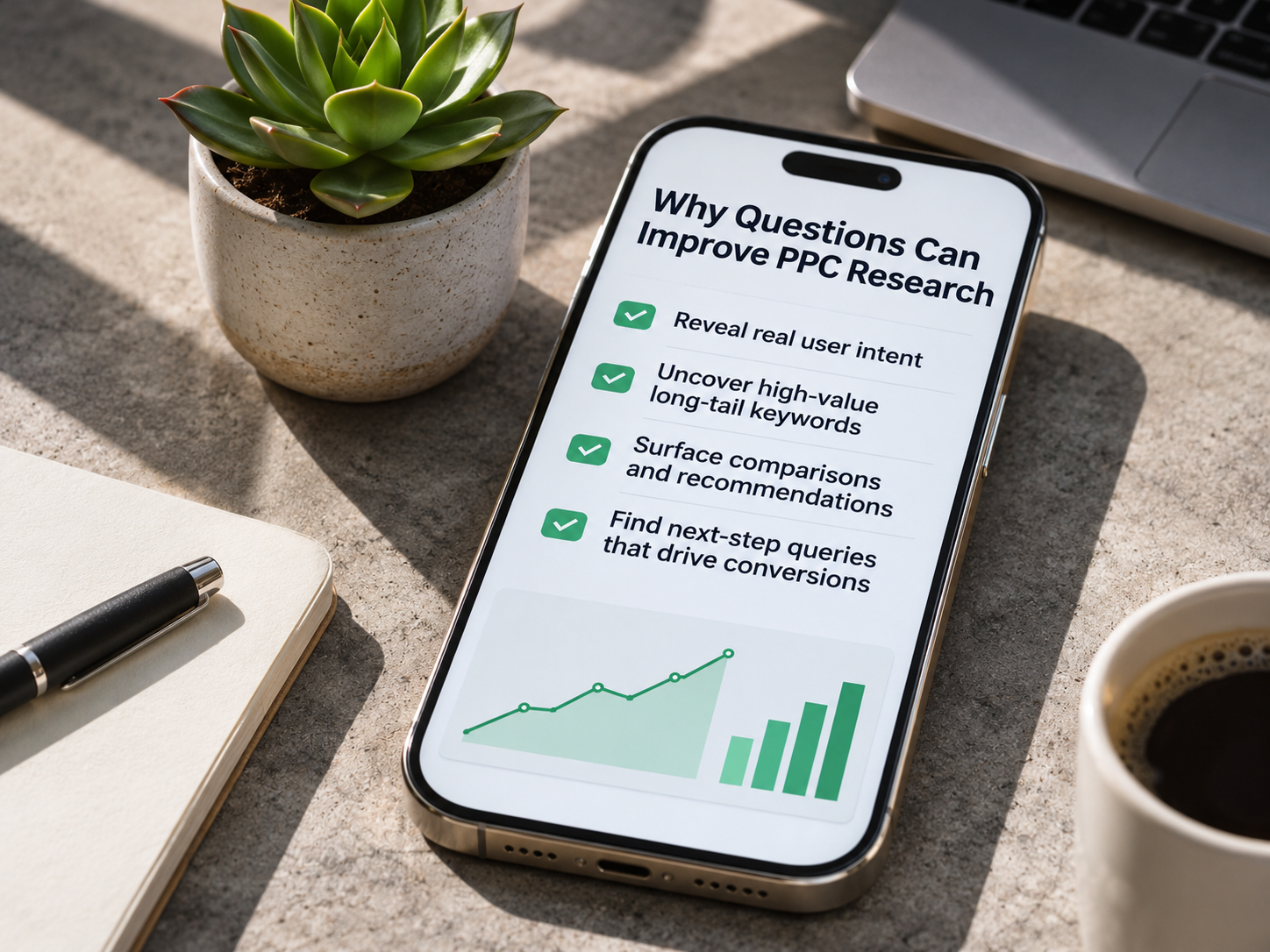
Why Questions Can Improve PPC Research

A conventional keyword such as “commercial energy consultant” tells you a broad subject. A question such as “How do I check whether our energy contract is costing too much?” may reveal a diagnostic need and a possible stage in the buying process. That distinction can help a team decide whether to write an educational page, create a comparison-focused landing page, or test a tightly themed ad group.
Questions can also expose language that internal teams overlook. Sales and product teams may describe a service differently from prospective customers. The wording can help generate candidate ad copy and landing-page headings, while the underlying need helps shape conversion rate optimization (CRO) hypotheses. It can inform B2B lead generation tactics, social media ad campaigns, and email marketing automation too, but each channel requires its own audience and performance validation.
The goal is not to put every conversational query into an account. It is to find recurring, commercially relevant needs, translate them into appropriate targeting options, and determine whether the resulting traffic produces qualified outcomes at an acceptable cost.
A Practical Research Workflow
1. Start with the business outcome
Define what the campaign should produce before collecting questions. For a B2B service, the outcome might be a qualified consultation request, a sales-accepted lead, or a completed assessment. Agree on the qualification criteria with sales: target company, geography, role, need, and any exclusions. For ecommerce or another model, use its relevant purchase or revenue outcome.
Then clarify the campaign constraints: service area, product eligibility, budget, conversion capacity, and claims the business can substantiate. These boundaries help separate questions that sound interesting from questions the business can answer and serve.
2. Gather questions from multiple sources
Use sources that reflect real customer language. Useful inputs may include search query reports where available, site-search terms, customer-support tickets, sales-call notes, CRM fields, community discussions, and interviews. Search Console and keyword-planning tools can add query and topic context, though their coverage and metrics depend on the tool and account.
You can also ask an AI tool to propose question variations based on a clearly described audience and service. Treat the output as brainstorming, not as observed customer behavior. Check each suggestion against first-party records, actual search results, customer conversations, or other evidence before treating it as a priority. Do not enter confidential client or customer data into an AI service unless its data-handling terms and your organization’s policies allow it.
3. Group questions by intent and funnel stage
Cluster questions by the task the searcher is trying to complete. A practical classification is:
- Problem discovery: “Why are our energy bills increasing?”
- Education: “How does an energy procurement adviser work?”
- Evaluation: “What should I compare when choosing an energy consultant?”
- Purchase or contact: “Energy advisers for manufacturers in my area.”
These are working categories, not universal labels. A question’s intent depends on context, industry, and the offer. Review search results and customer evidence rather than assigning intent from wording alone. Record the intended audience, likely stage, problem, and desired next step for each cluster.
4. Translate questions into PPC candidates
Pull out the core subject and its useful modifiers: service, audience, location, problem, comparison, and urgency where appropriate. For example, a question about checking an energy contract might lead to candidates around energy contract review, commercial energy audit, or energy procurement advice. These are research candidates, not guaranteed platform keywords.
Check whether the advertising platform supports relevant query targeting and what match types, audience controls, or campaign settings are available in the account. Search campaigns generally use keyword and match-type controls rather than targeting the full wording of every natural-language question as a distinct item. Review search-term reporting after launch where it is provided, and use negative keywords or other exclusions thoughtfully. Match the campaign structure to meaningful differences in intent, not every wording variation.
5. Validate demand, competition, and economics
Use available keyword-planning and account data to assess whether candidate terms have observable demand, and check live search results to understand what kinds of pages and advertisers appear. Estimates are directional, not guarantees of impressions or conversions. In a specialist B2B market, low reported volume may not mean a question is unimportant; conversely, a large audience does not establish that it will become profitable.
Estimate allowable acquisition cost using the business’s own economics and conversion history. Include lead qualification and sales outcomes where possible, not just form submissions. If the expected value is uncertain, treat the campaign as a bounded test with a documented budget and decision rule. Avoid forecasting return from question counts alone.
6. Align the landing page with the need
Send evaluation-stage traffic to a page that explains the service, who it is for, evidence supporting its claims, and what happens after contact. A page for an educational query may need a useful explanation before asking for a sales conversation. Keep the promise in the ad consistent with the destination, make the next action clear, and avoid implying an outcome the company cannot substantiate.
Use question clusters to form CRO hypotheses. For example: “Visitors asking about contract review may need a clear explanation of what the review includes before they will request one.” Test one meaningful change at a time where traffic permits, and evaluate qualified conversion outcomes. Landing page design and testing are not substitutes for accurate targeting or a credible offer.
7. Measure and refine across the funnel
Track a chain of outcomes: eligible traffic, landing-page engagement, conversion, lead qualification, sales acceptance, and revenue where it can be connected responsibly. Use consistent conversion definitions and check that analytics and ad-platform tags are functioning. For longer B2B sales cycles, record source and campaign details in the CRM and use an attribution approach that stakeholders understand.
Attribution is imperfect. Consent choices, browser restrictions, cross-device journeys, platform reporting differences, and offline sales activity can all affect what is observed. Compare multiple views, such as platform reports, web analytics, and CRM outcomes, and document their limits. Do not interpret an attributed conversion as proof that one channel caused the entire sale.
Evidence and Case-Study Context
Published case studies can illustrate how practitioners combine channels, but they should not be treated as independent proof that a tactic will work for another advertiser. For example, Fuel Online’s “Fintech PPC GEO Integration” case study is relevant to the intersection of paid search and generative-engine optimization. It is useful as an example of a combined search strategy, not as validation that AI-question targeting alone produces a particular outcome.
Brafton’s “From Questionable to Qualified Leads: 100 PPC Conversions for a Leading Energy Advisory Firm” provides a paid-search example framed around lead quality. The title identifies the case’s stated subject; any results or methods should be interpreted in the context and definitions provided on the case-study page. An additional practitioner perspective is Lead Marketing Strategies’ PPC and paid-search post on LinkedIn. A social post can suggest questions to investigate, but it is not a substitute for account data or a controlled test.
A sound comparison method is to evaluate each source by its stated objective, audience, channel mix, measurement definition, time period, and whether it reports qualified business outcomes or only platform conversions. These examples are directional references; they do not establish a universal benchmark.
Pros, Cons, and Limitations
Potential benefits
- Questions can reveal needs, constraints, and objections hidden by broad keyword labels.
- They can help connect SEO and content strategy with paid-search messaging and landing-page hypotheses.
- They provide a useful structure for organizing research by intent and funnel stage.
- They can support better conversations between marketing, sales, and customer-support teams.
Risks and limitations
- AI-generated questions may be plausible but unrepresentative or entirely hypothetical.
- Search-volume estimates and query visibility are incomplete, particularly for niche or emerging topics.
- Natural-language phrasing does not map one-to-one to platform targeting controls.
- Broad informational questions can attract visitors who are not eligible buyers, increasing lead volume without improving lead quality.
- Attribution and conversion tracking can misstate channel contribution when data is missing, delayed, or defined inconsistently.
For these reasons, use question research to improve hypotheses, not to bypass normal PPC governance. Scale only when downstream evidence supports doing so. A performance marketing agency scaling a campaign should preserve control groups or other appropriate comparisons when practical, monitor lead quality as spend changes, and keep a record of major targeting and landing-page changes. Social media campaigns and automated email follow-up may extend a journey, but they should be measured separately and coordinated with consent and contact policies.
Concise Q&A
Can AI search questions replace keyword research tools?
No. They add qualitative context. Use keyword tools, platform reporting, search results, and customer evidence to validate demand and targeting options.
Should every question become a paid keyword?
No. Many questions are better suited to educational content, sales enablement, or no action. Prioritize by business relevance, evidence of demand, targeting feasibility, and expected economics.
How many questions should a campaign test?
There is no universal number. Group related questions into a manageable set of themes that the campaign can measure with its available traffic and budget. Avoid splitting a small audience across many weakly differentiated ad groups.
How do I know whether the research worked?
Judge it by whether it improves qualified outcomes and decision-making, not by how many questions were collected. Compare lead quality, sales acceptance, and revenue alongside ad and web metrics.
Conclusion
AI search questions are useful when they expose customer language and unmet information needs. Turn them into structured hypotheses, validate them against real customer and search evidence, map them to feasible PPC targeting, and send each intent to a relevant page. Then measure the full journey, including lead quality and revenue where possible. That disciplined process makes question-led keyword research a practical input to paid ads and PPC optimization, while keeping SEO, CRO, analytics, attribution, and B2B lead generation connected to the outcomes the business actually values.
Informational disclaimer: This article describes general marketing research practices, not financial or legal advice. Advertising decisions involve business risk; validate assumptions with your own data, platform documentation, and applicable privacy and advertising requirements.
Leave a Reply