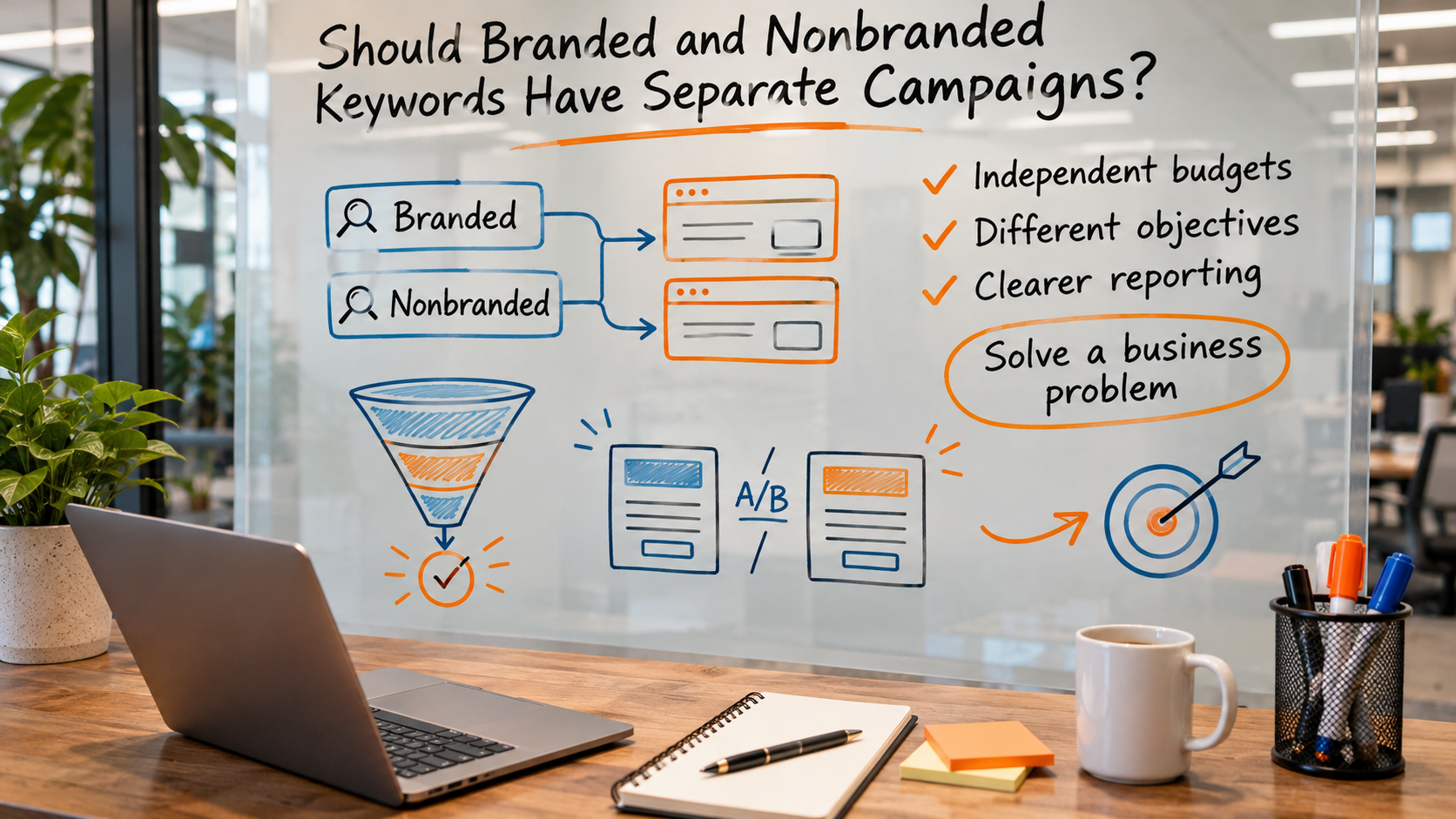
Should branded and nonbranded keywords have separate campaigns? Usually, yes—when you need independent budgets, different objectives, or clearer reporting. However, separation should solve a business problem. Google recommends organizing campaigns around objectives while keeping account structures simple. For a performance marketing agency, the practical decision is whether the extra control justifies the additional management. Campaign separation is a useful starting recommendation, not a guarantee of better results. ([support.google.com](https://support.google.com/google-ads/answer/6167145?hl=en&utm_source=openai))
This guide explains how to make that decision, implement it, and evaluate performance without confusing attributed conversions with additional business.
What Are Branded and Nonbranded Keywords?
For this guide, branded keywords are searches containing your company name, a distinctive product brand, or a recognizable variation. Nonbranded keywords describe a service, product category, problem, or requirement without identifying your business.
Consider a fictional agency called Cedar Peak Media. “Cedar Peak Media PPC services” would be branded. “Performance marketing agency for software companies” would be nonbranded. Classify searches naming competing agencies separately as competitor terms, even though they do not contain your own brand.
Campaign separation means placing these groups in distinct campaigns. It is different from putting them in separate ad groups within one campaign: Google Ads assigns budgets and several targeting settings at campaign level, while ad groups organize related ads and keywords. Separate ad groups therefore do not provide independent campaign budgets. See Google Ads’ account organization guidance. ([support.google.com](https://support.google.com/google-ads/answer/1704396?ctx=blog&hl=en&utm_source=openai))
Why Separate Brand and Nonbrand Campaigns?

Control spending according to purpose
If the brief requires a defined budget for brand searches and a separate allocation for category discovery, use distinct campaigns with independent budgets. Campaign settings support that division. Avoid reconnecting those budgets through a shared arrangement if independent spending control is the objective. ([support.google.com](https://support.google.com/google-ads/answer/6304?hl=en-en&utm_source=openai))
Set each allocation from your commercial priorities and account evidence. Do not assign a fixed percentage simply because another advertiser uses it. Ask what each campaign must accomplish, how much qualified demand exists, and what spending level the business can support.
Make reporting easier to interpret

Imagine a prospect first discovers your business through a category search, then returns through a branded search before submitting an inquiry. Google’s attribution documentation illustrates this kind of journey: last-click attribution assigns credit to the final interaction, while data-driven attribution can distribute credit across interactions. Separate reporting helps you examine those patterns, although it does not establish causation. ([support.google.com](https://support.google.com/google-ads/answer/6259715?hl=en&utm_source=openai))
In agency reporting, show brand and nonbrand performance alongside the combined account result. This makes it easier to question whether apparent improvement reflects stronger acquisition, a changing traffic mix, or a different attribution outcome.
Use different objectives when justified
A brand campaign might have an explicit visibility objective, while a nonbrand campaign focuses on qualified inquiries. Google advises that a campaign should generally have one objective and recommends separate campaigns when optimization objectives differ. The distinction should follow the business brief, rather than an assumption that every brand campaign must prioritize visibility. ([support.google.com](https://support.google.com/google-ads/answer/6167145?hl=en&utm_source=openai))
The Tradeoffs and When to Keep Things Simple
Separation creates additional settings, exclusions, budgets, and reports to maintain. Before splitting, assign an owner to each of those tasks. If the only requirement is different ad messaging, first consider whether separate ad groups would meet it.
Google also recommends simplifying account structure and explains that its bidding systems can apply query-level learning across an account. Do not assume that each new campaign creates a completely isolated learning system—or that more campaigns automatically improve optimization. ([support.google.com](https://support.google.com/google-ads/answer/6167110?hl=en&utm_source=openai))
For a small account, consider retaining a simpler structure temporarily when brand activity is minimal, objectives are identical, and independent budgets would add little practical value. Record that as a deliberate decision. Revisit it when brand demand, spending requirements, or reporting needs change.
There is no universal conversion threshold that decides this question. Google’s bidding guidance makes clear that data recommendations depend on the strategy and campaign type. Evaluate the relevant guidance and your conversion delay before making structural decisions based on volume alone. ([support.google.com](https://support.google.com/google-ads/faq/10286469?hl=en&utm_source=openai))
What the Evidence Supports—and What It Does Not
The following sources inform different parts of the recommendation. The comparison method is to distinguish platform documentation about campaign mechanics from agency descriptions of client work and practitioner commentary. None of the three supplied marketing sources establishes a controlled comparison of combined versus separate brand campaigns.
Fuel Online: coordinate search intent across channels
Fuel Online’s integrated PPC and GEO fintech case study describes using organic and AI-search insights to revise paid-search targeting, align landing pages, and redistribute spending. Its relevance here is coordination between SEO, content strategy, and PPC. Treat its reported outcomes as agency-reported results, not proof that brand separation caused an improvement. ([fuelonline.com](https://fuelonline.com/case-studies/fintech-ppc-geo-integration/?utm_source=openai))
Do not infer that adding schema markup automatically reduces advertising costs. Google describes Quality Score as a diagnostic tool, not an auction input. The case study’s explanation of that mechanism should therefore be treated cautiously. ([support.google.com](https://support.google.com/google-ads/answer/6167118/about-quality-score?hl=en&utm_source=openai))
Brafton: measure lead quality beyond form submissions
Brafton’s energy advisory PPC case study describes rebuilding conversion tracking, improving landing pages, targeting high-intent searches, and refining geographic coverage. It also discusses qualified opportunities and closed business. Because several interventions occurred together, the case supports examining the whole lead-generation process rather than attributing results to campaign structure alone. ([brafton.de](https://www.brafton.de/case-studies/from-questionable-to-qualified-leads-100-ppc-conversions-for-a-leading-energy-advisory-firm/))
Lead Marketing Strategies: choose metrics by objective
Lead Marketing Strategies’ LinkedIn post on PPC and ROI advocates distinct performance measures for awareness and lead generation, alongside landing-page testing. It is practitioner commentary, not an independent experiment. Brand awareness also differs from branded search: the post does not directly demonstrate that branded keywords require separate campaigns. ([linkedin.com](https://www.linkedin.com/posts/leadmarketingstrategies_ppc-digitalmarketing-paidsearch-activity-7415803231916007424-mL_G))
How to Separate Campaigns in Practice
1. Establish a query classification rule
Review the search terms available in your account and classify them as own-brand, nonbrand, competitor, or ambiguous. Include distinctive product names and combinations of brand plus service. Keep the rules in a shared document so analysts apply the same definitions.
For ambiguous company names that also describe ordinary products or services, review context before classifying. In the working taxonomy above, a brand-plus-service search remains branded. It should not become nonbranded simply because it contains a commercially valuable category term.
2. Define meaningful conversion outcomes
Agree with sales on what constitutes a qualified lead, an opportunity, and a customer. Google Ads supports qualified-lead and converted-lead goals using offline outcomes from a CRM or another lead-management system. This provides a basis for assessing B2B lead generation beyond initial inquiries. ([support.google.com](https://support.google.com/google-ads/answer/11459091?hl=en&utm_source=openai))
Before restructuring, audit duplicate events, inconsistent definitions, and missing outcomes. Select a bidding goal that reflects business value and has sufficiently reliable reporting. Google’s lead-quality guidance recommends choosing an optimization goal aligned with the business rather than selecting multiple funnel stages indiscriminately. ([support.google.com](https://support.google.com/google-ads/answer/13489421?hl=en&utm_source=openai))
3. Create the smallest useful structure
A practical starting design is one own-brand Search campaign and one nonbrand Search campaign, with relevant ad groups inside each. Add a competitor campaign only if competitor targeting is an approved part of the strategy. This is a proposed structure, not a platform requirement.
Expand beyond it only when a clear operational reason exists, such as different objectives or campaign-level targeting requirements. Google’s account setup guidance supports relevance and simplicity rather than routine segmentation by every available variable. ([support.google.com](https://support.google.com/google-ads/answer/6167145?hl=en&utm_source=openai))
4. Configure exclusions at the correct scope
Apply own-brand negatives to the intended nonbrand Search campaigns, using appropriate match types. Google supports campaign-specific negative keyword lists. Avoid placing those brand terms in an account-wide list when you still want the brand campaign to serve: account-level negatives affect relevant inventory across the account. ([support.google.com](https://support.google.com/google-ads/answer/7449003?hl=en-en&utm_source=openai))
Review search terms after implementation rather than assuming a list captures every variation. Google documents differences between negative and positive keyword matching, including limits on close-variant coverage. ([support.google.com](https://support.google.com/google-ads/answer/2453972?hl=en&utm_source=openai))
If Performance Max or AI Max for Search is involved, review the applicable brand controls too. Google documents brand exclusions and their inventory-specific behavior, including an option to retain Shopping ads for excluded brand searches. Check the actual campaign configuration before describing it as brand-free. ([support.google.com](https://support.google.com/google-ads/answer/14505308?hl=en_us_us&utm_source=openai))
5. Assign budgets and bidding deliberately
Write down the spending purpose, conversion objective, and review criteria for each campaign. For nonbrand acquisition, consider qualified-lead cost and eventual customer value. For brand, decide whether the primary requirement is profitable conversions, visibility, or a bounded experiment.
Google offers conversion-focused and conversion-value-focused bidding strategies. Choose among them according to the business objective and the quality of the available measurement. Do not copy a brand campaign’s target into nonbrand solely to make the dashboard look consistent. ([support.google.com](https://support.google.com/google-ads/faq/10286469?hl=en&utm_source=openai))
6. Test landing pages against specific hypotheses
Use separation to organize a conversion rate optimization plan. For brand visitors, test whether a direct route to the requested service improves qualified inquiries. For category visitors, test whether clearer service explanations, relevant evidence, and qualification criteria improve outcomes.
Measure lead quality alongside form completion. Brafton’s case illustrates why landing-page work and sales feedback belong in the same review, although it does not isolate the effect of any individual page change. ([brafton.de](https://www.brafton.de/case-studies/from-questionable-to-qualified-leads-100-ppc-conversions-for-a-leading-energy-advisory-firm/))
7. Document the change and evaluate mature outcomes
Record the launch date, exclusions, budgets, bidding objectives, and landing-page changes. Define success before reviewing results: for example, better spending control with stable qualified demand. Allow the evaluation period to reflect your sales cycle and conversion delay.
Avoid claiming that a before-and-after improvement proves causation. For causal measurement, Google describes controlled lift experiments that compare exposed and control groups. Campaign reporting answers a different question. ([support.google.com](https://support.google.com/google-ads/answer/12003020?hl=en&utm_source=openai))
Connect Attribution, ROI, and Other Channels
Keep attributed results and incremental results distinct. Attribution allocates conversion credit; incrementality estimates what happened because advertising was present. Google explicitly distinguishes standard attributed conversions from Conversion Lift results. Separate brand campaigns make the reporting easier to organize, but separation itself is not an incrementality test. ([support.google.com](https://support.google.com/google-ads/answer/6259715?hl=en&utm_source=openai))
Where scale and eligibility permit, consider a controlled brand-spend experiment with an appropriate control group. Google notes that Conversion Lift is not available to every account. If a credible experiment is unavailable, label conclusions as observational and disclose the uncertainty. ([support.google.com](https://support.google.com/google-ads/answer/12003020?hl=en&utm_source=openai))
For broader performance marketing agency scaling, use a shared review across paid search, SEO, social media advertising, and email automation. Compare campaign dates, offers, CRM outcomes, and customer status. Treat possible relationships between those activities and branded searches as hypotheses to investigate.
In ROI reporting, state which costs and outcomes are included. Keep revenue-based advertising returns separate from a profitability assessment that includes delivery costs and marketing expenses. Use the same definitions across brand and nonbrand reports so budget decisions remain comparable.
Concise Q&A
Should branded and nonbranded keywords always have separate campaigns?
No. Separate them when independent budgets, different objectives, or reporting requirements justify the work. A simpler structure can be appropriate when those differences are immaterial. This follows Google’s emphasis on objective-based campaigns and account simplicity. ([support.google.com](https://support.google.com/google-ads/answer/6167145?hl=en&utm_source=openai))
Are separate ad groups enough?
They can organize different keywords and ads, but they do not create independent campaign budgets. Use separate campaigns when budget control is the deciding requirement. ([support.google.com](https://support.google.com/google-ads/answer/1704396?ctx=blog&hl=en&utm_source=openai))
Does a strong brand campaign prove that advertising created new demand?
No. Attributed conversions and incremental conversions measure different things. Evaluate causation through an appropriately designed experiment rather than relying on campaign efficiency alone. ([support.google.com](https://support.google.com/google-ads/answer/14102450?hl=en-11&utm_source=openai))
What should an agency recommend first?
Start with a measurement audit and a written business objective. Then propose the simplest structure that provides the required control. Treat the initial setup as a decision to evaluate against qualified leads, customer outcomes, and spending priorities.
Informational disclaimer: Advertising involves financial risk. These recommendations are educational; results depend on your market, execution, measurement, and budget.
Leave a Reply