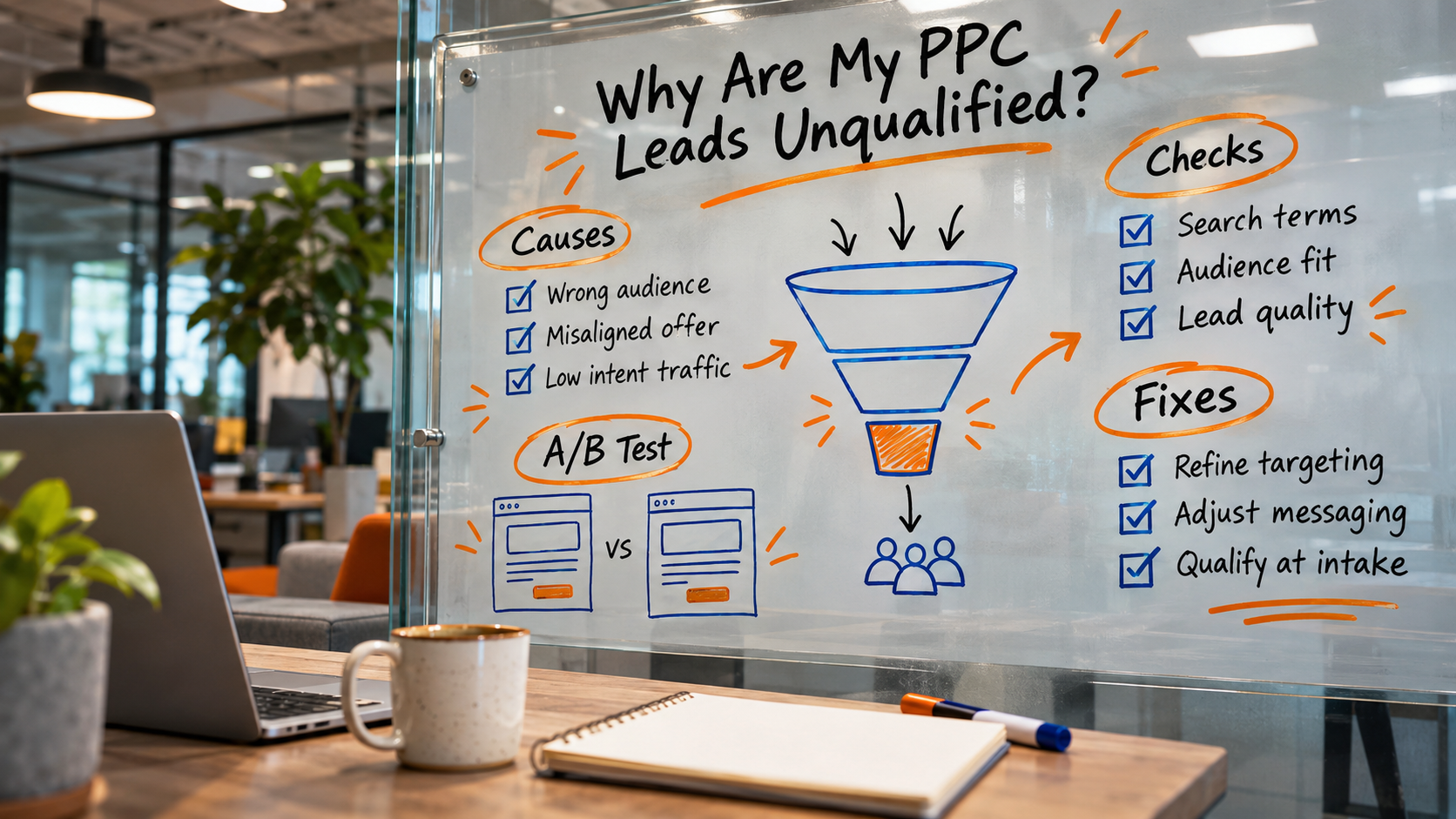
If you are asking, “why are my ppc leads unqualified,” the problem may not be the number of form submissions. It may be a mismatch between the people your campaigns attract and the people your sales team can serve. A paid campaign can generate plenty of conversions while producing few prospects with the right need, authority, budget, location, or timing.
That mismatch can arise from targeting, search intent, ad messaging, landing-page design, form choices, measurement, or follow-up. In some cases, the leads are appropriate but the business’s qualification criteria are unclear or unrealistic. The useful response is to trace the full path from query or audience through the ad, landing page, CRM, and sales outcome—not to change bids or pause campaigns on the basis of a vague label.
What does “unqualified PPC lead” mean?
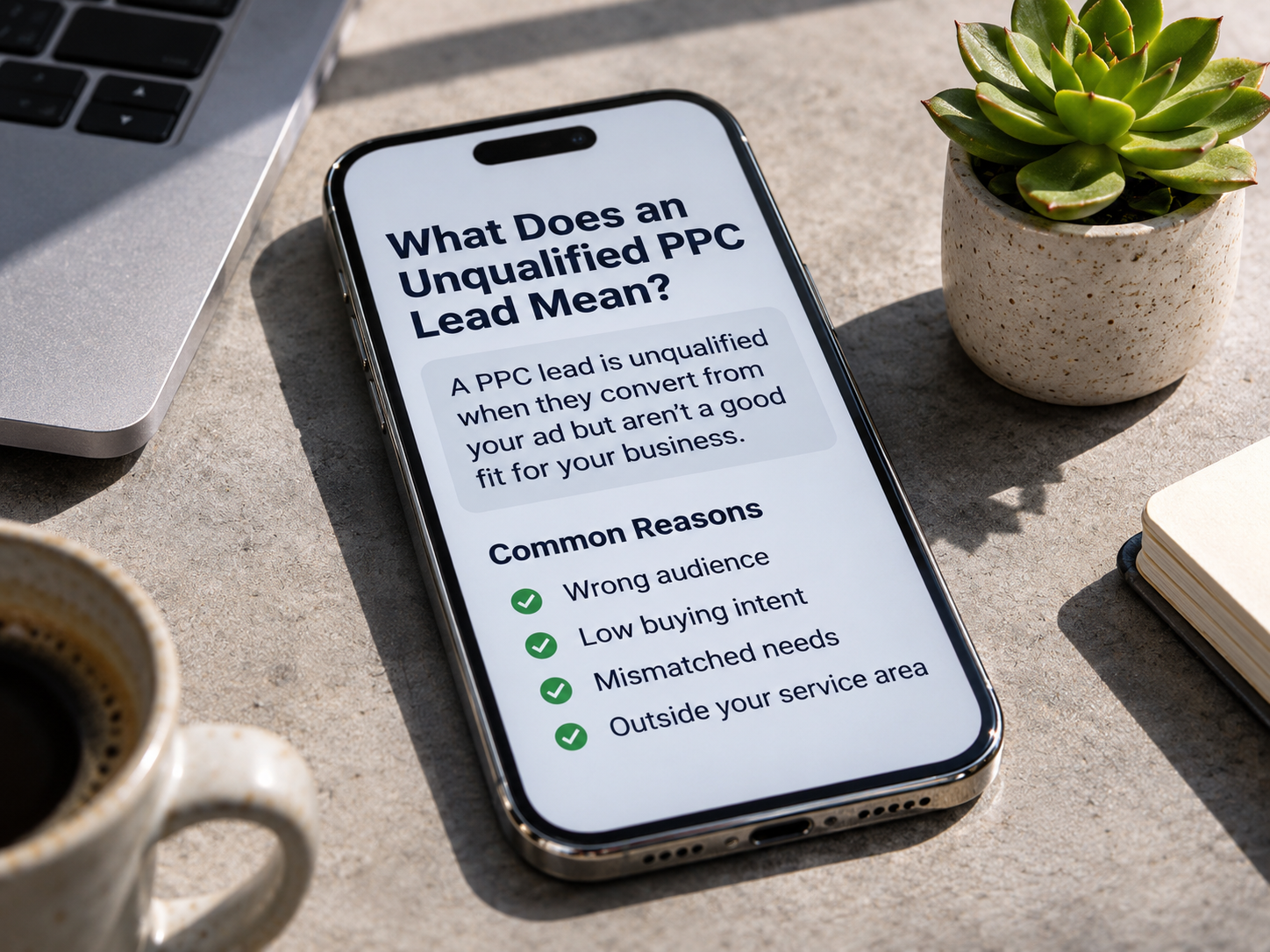
A qualified PPC lead is a person or organization that meets agreed criteria for a realistic sales opportunity. Those criteria depend on the offer. A B2B company might consider industry, company size, role, location, need, purchasing authority, and buying timeframe. A local service business may care more about service area, job type, and whether the person is ready to request an estimate.
An unqualified lead fails one or more of those defined criteria, or cannot be assessed because the available information is incomplete. This is different from a lead that has not yet been contacted, a legitimate prospect who is not ready to buy today, or a lead that sales has not followed up with promptly. Define the categories before comparing campaign performance; otherwise, “unqualified” can become a subjective catch-all.
Why PPC campaigns attract the wrong leads
1. Keywords capture research intent, not buying intent
Search terms can look relevant while signaling very different needs. Someone searching for a definition, template, free tool, job, or training may not be looking to purchase your service. Broad match and automated campaign types can reach queries beyond the exact phrases a marketer had in mind, so the actual search terms need regular review where the platform provides them.
Separate keywords and campaigns by intent. Commercial phrases such as “consulting firm for” or “request a quote” may merit different messaging and budgets from educational searches such as “how does” or “what is.” Add negative keywords where they clearly exclude irrelevant intent, but review them carefully: an overbroad exclusion can block a valuable prospect.
2. Audience or geographic settings do not match the offer

Campaigns can reach people outside a serviceable region, business segment, or intended buying group. Check location options, exclusions, language, device performance, audience expansion settings, and any automated targeting controls. Platform settings and terminology change, so confirm the current configuration in the account rather than relying on an old checklist.
For B2B lead generation, a job title alone is rarely a complete definition of a buyer. A relevant decision-maker may use a different title, while a person with a matching title may have no need or authority. Combine audience signals with the offer, search intent, and qualification data rather than treating any single targeting field as proof of fit.
3. The ad promises more than the landing page or sales process delivers
Ad copy can attract the wrong expectations when it is broad, vague, or out of step with the actual offer. If an ad implies a free service, instant result, or universal solution but the page describes a paid, specialized engagement, some submissions will be disappointed or unsuitable. Keep claims specific and consistent across the ad, landing page, form, and sales conversation.
Landing-page design matters too. A prominent form with little context may encourage low-intent submissions. A page that explains who the service is for, what problem it addresses, what happens next, and what is not included helps people self-select. Test page changes with a clear hypothesis; do not assume that adding more copy or fields will automatically improve lead quality.
4. Conversion tracking counts actions, not business value
A platform may optimize toward a form submission even if that submission is spam, a duplicate, or a poor fit. If every conversion is treated as equally valuable, the campaign has little feedback about what the company actually wants. Check that tags fire once, events correspond to genuine actions, and calls or CRM outcomes are recorded consistently.
Where feasible, connect qualified-lead or opportunity outcomes back to advertising platforms using an appropriate CRM integration or offline conversion process. Respect consent requirements and applicable privacy rules. Do not upload more personal data than necessary, and verify that identifiers, timestamps, and conversion definitions are handled correctly.
5. Qualification and follow-up are inconsistent
Sales teams may apply different standards, leave fields blank, or mark leads unqualified without a reason. Delayed outreach can also make a genuine prospect appear unresponsive. Agree on definitions across marketing and sales, record a standardized disqualification reason, and review response processes alongside campaign settings. An agency cannot optimize reliably against feedback that is missing or contradictory.
How to diagnose the problem: practical steps
- Write down the qualification rules. Agree on the minimum criteria for a marketing-qualified lead and a sales-qualified lead. Include explicit exclusions, such as unsupported locations or service requests the business does not handle.
- Audit lead records. Sample recent submissions by campaign, ad group, keyword or audience, landing page, and date. Look for patterns in fit, spam, duplicates, missing information, and sales outcomes. Use a consistent sample and record the reason for each judgment rather than relying on anecdotes.
- Inspect search terms and targeting. Identify research, employment, education, freebie, competitor, or unrelated queries where relevant. Check geographic reach and audience settings. Add exclusions only when the evidence supports them.
- Compare promise with delivery. Review the ad, landing page, form, confirmation message, and first sales contact as one journey. Make the audience, service scope, and next step clear. If the offer is not intended for small businesses, for example, state the relevant company requirements rather than hoping prospects infer them.
- Review forms thoughtfully. Ask only for information that supports routing or qualification. A question about company size or project type may help, but every additional field can create friction. Consider progressive qualification or separate paths for different buyer needs.
- Validate analytics and CRM feedback. Test events, deduplication, call tracking, source capture, and lead-status updates. Confirm that a qualified lead is not counted twice and that later outcomes remain connected to the original campaign where the measurement setup allows.
- Optimize to meaningful outcomes. Once tracking is reliable and there is sufficient conversion feedback, consider bidding or budget decisions based on qualified leads or downstream outcomes—not raw form volume alone. Changes to bidding and attribution can take time to stabilize, and small data sets may not support confident conclusions.
- Run controlled tests. Test one meaningful change at a time where practical: a tighter keyword set, clearer offer, different page message, or form adjustment. Compare lead quality and cost alongside conversion rate. Avoid declaring a winner from a few submissions or changing many variables at once.
Use evidence carefully when evaluating PPC improvements
Published case studies can suggest useful questions, but they do not guarantee the same result for another advertiser. For example, Fuel Online’s fintech PPC and geo-integration case study is relevant when considering how paid search and geographic context may be combined. It is a vendor case study, so treat it as an example of an approach, not independent proof that geo-targeting will solve lead quality in every account.
Brafton’s case study on improving lead quality for an energy advisory firm is another named example focused on the distinction between questionable and qualified PPC leads. Its client, market, campaign setup, and reporting definitions may differ from yours. Ask what counts as a qualified conversion, what period was measured, and whether the reported outcome is attributable to paid media alone.
The post from Lead Marketing Strategies on PPC and paid search can be read as practitioner commentary. A social post is not the same as a controlled study. Use it to generate questions for your own account review, not as evidence of a universal benchmark.
A sound comparison method is to use your own CRM-defined outcomes, compare like-for-like campaign periods where possible, and document changes in spend, targeting, offer, sales handling, and seasonality. Case studies may inform hypotheses; your validated account data should determine whether a change is working.
Pros and cons of stricter qualification
Potential benefits
- Sales teams can spend more time on prospects that fit the service and buying process.
- Campaign reporting can better reflect pipeline quality and business outcomes, not just submission volume.
- Clearer messaging may help unsuitable visitors identify themselves before submitting a form.
Trade-offs and risks
- More form questions or restrictive targeting can reduce conversion volume and may exclude legitimate buyers who are early in their research.
- Qualified-lead optimization depends on accurate, timely CRM feedback and enough usable conversion data.
- Lead quality is not solely an advertising issue. Sales coverage, pricing, product fit, response speed, and changing market conditions can affect outcomes.
For these reasons, do not equate fewer leads with better performance. Track qualified-lead rate, cost per qualified lead, opportunity creation, and revenue where attribution is sufficiently reliable. Interpret those measures alongside total volume and the business’s capacity to serve new customers.
How a performance marketing agency can help
A capable performance marketing agency can audit account structure, search intent, campaign settings, conversion tracking, landing pages, and CRM feedback together. It may also coordinate paid ads and PPC optimization with conversion rate optimization (CRO), SEO and content strategy, social media ad campaigns, and email marketing automation. For example, educational content can serve early-stage research while paid campaigns focus on clearer commercial intent; automated follow-up can route a legitimate but not-yet-ready lead into an appropriate nurture path.
Ask an agency how it defines lead quality, which CRM fields it uses, how it distinguishes platform conversions from qualified outcomes, and how it reports attribution limitations. Also clarify who owns landing-page changes, privacy reviews, sales feedback, and tracking maintenance. A campaign cannot be responsibly scaled just because the advertising dashboard reports more conversions.
Limitations of PPC lead-quality analysis
Attribution is imperfect. People may see an ad, return through another channel, use multiple devices, or convert after a long sales cycle. Privacy settings and consent choices can limit what is observable. CRM records may be incomplete, and a lead’s eventual value can take months to emerge. Small samples, seasonal shifts, and changes in sales operations can make short-term comparisons misleading.
Use more than one view of performance: platform data for campaign operations, CRM data for qualification and pipeline, and broader business reporting for revenue. Reconcile differences rather than pretending that any one source captures the full customer journey. Document assumptions and avoid presenting attributed revenue as certain causal impact unless the measurement design supports that conclusion.
Q&A
Should I pause a campaign if it generates unqualified leads?
Not automatically. First check whether the leads are consistently unsuitable, whether tracking and qualification labels are reliable, and whether a targeted change can address the issue. Pause or limit spending if there is a clear business or compliance concern, but avoid making a major decision from a handful of records.
Will adding more form fields improve lead quality?
It may help qualify or route submissions, but it can also discourage suitable prospects. Add fields only when the information has a clear operational use, then assess both lead quality and the effect on conversion volume.
Is a low cost per lead a sign that PPC is working?
It is a cost measure, not a quality measure. Compare it with qualified-lead cost, opportunity progression, and outcomes relevant to your business, while accounting for attribution uncertainty and sales-cycle length.
Can an agency guarantee qualified leads?
No responsible agency can guarantee a particular lead quality independent of the offer, market, budget, sales process, and data quality. An agency can explain its methods, set measurable definitions, and report what the available evidence does and does not show.
Conclusion
When PPC leads are unqualified, trace the mismatch rather than assuming the cause is simply “bad traffic.” Define qualification, inspect real lead records, review intent and targeting, align the ad with the landing page, and make sure analytics and CRM outcomes are trustworthy. Then test changes against both lead quality and volume. That process gives a performance marketing team a more defensible basis for improving campaigns—and for deciding whether paid media, the offer, the sales process, or several parts of the funnel need attention.
Informational disclaimer: This article provides general marketing guidance, not financial, legal, or platform-specific advice. Confirm current advertising and privacy requirements with qualified professionals where appropriate.
Leave a Reply